We asked students to test our European cloud against Azure. Here is what they found
By Alec on
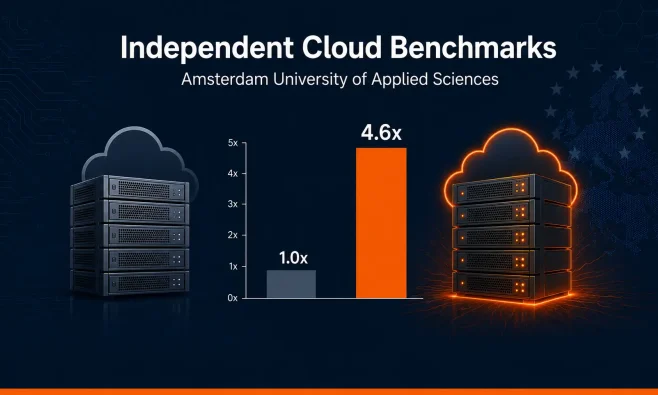
Most cloud benchmarks come from the company selling you the cloud. This one does not. As part of our work with the Amsterdam University of Applied Sciences, a group of students ran their own tests comparing Microsoft Azure with Cyso Cloud, our OpenStack-based platform. They had no stake in the result. They just wanted to know which platform did more, for less.
If you are weighing up a European cloud alternative to Azure, independent numbers are worth more than any sales deck. So here they are, including the parts where Azure came out ahead.
How the students tested it
The students benchmarked 13 Azure VM sizes against 8 Cyso flavours, all running Ubuntu 22.04. Azure machines were deployed in West Europe. They measured CPU with sysbench prime computation, memory throughput with sysbench memory, and disk speed with synchronous writes.
The whole thing was automated end to end. A script deployed each machine with Terraform, ran the tests over SSH, saved the numbers, and tore the machines down afterwards to keep costs honest. Same operating system, same method, every time. That repeatability is what makes the results worth reading.
CPU: four to six times faster at the same core count
This was the headline finding, and the students called it out themselves. Cyso runs on AMD EPYC Milan processors, while the Azure machines they tested used Intel Xeon Platinum. At the same number of vCPUs, Cyso came out consistently faster on CPU work.
Comparison | Azure (events/s) | Cyso (events/s) | Cyso advantage |
|---|---|---|---|
2 vCPU general purpose | 1,342 (D2s_v3) | 6,343 (s5.small) | 4.7x faster |
2 vCPU compute | 1,808 (F2s_v2) | 8,059 (c5.small) | 4.5x faster |
4 vCPU general purpose | 2,067 (D4s_v3) | 12,562 (s5.medium) | 6.1x faster |
4 vCPU compute | 3,604 (F4s_v2) | 16,246 (c5.medium) | 4.5x faster |
The practical takeaway matters more than the multiples. If you run on a D2s_v3 today, you do not need to match its vCPU count to keep the same performance on Cyso. You could pick a smaller flavour and still have room to spare, or keep the same core count and simply get far more out of it.
Cost: the same specs for a fraction of the price
The speed gap is only half the story. The students also mapped common Azure sizes to their closest Cyso flavour and compared the monthly bill.
Azure size | Azure price/mo | Closest Cyso | Cyso price/mo | Saving/mo |
|---|---|---|---|---|
D2s_v3 (2 vCPU, 8 GiB) | $87.60 | s5.small | €17.50 | ~€70 |
D4s_v3 (4 vCPU, 16 GiB) | $175.20 | s5.medium | €37.50 | ~€138 |
E4s_v3 (4 vCPU, 32 GiB) | $233.60 | m5.medium | €53.50 | ~€180 |
F4s_v2 (4 vCPU, 8 GiB) | $141.62 | c5.medium | €43.75 | ~€98 |
Put the two findings together and you get the real argument for a move. On a D2s_v3, switching to an s5.small cut the monthly cost by roughly 80 per cent and delivered nearly five times the CPU throughput at the same time. Cheaper and faster is a rare pairing, and you can check the current flavour pricing yourself before you take our word for it.
Check our current pricingWhere Azure still wins
A test you can trust is one that admits the other side has strengths, so here are the places where Azure held its ground.
Memory bandwidth went to Azure. The F4s_v2 reached 10,931 MiB/s, almost double the best Cyso result of 5,860 MiB/s. If your workload lives and dies by memory bandwidth, an in-memory database for example, measure that before you move.
Storage works differently on each platform. Azure uses managed SSDs with predictable IOPS. Cyso uses Ceph distributed storage, where performance depends on cluster load and the network. Write speeds were broadly similar across both, but the behaviour under heavy synchronous writes is something to plan for if your work is I/O heavy. Cyso's read speeds during testing were exceptionally high, but that reflects Ceph page cache rather than sustained disk read performance, so those numbers are not included here.
Azure B-series machines work differently from every other VM type in this comparison. Rather than delivering a fixed amount of CPU performance continuously, they accumulate credits when idle and spend those credits during short bursts of higher load. The benchmark scores in this test reflect that burst state: a B2s recorded 1,719 events/s, which actually looks competitive on paper. But once the credits run out under sustained load, performance drops significantly. The students flag this directly: if you are running on B-series today, measure your actual CPU usage pattern before choosing a Cyso flavour, because a direct vCPU-for-vCPU match may leave you short under real conditions.
What the students built alongside the tests
The benchmarks were one part of the project. The students also built a desktop tool to migrate virtual machines from Azure to Cyso, turning what is usually a stack of command-line steps into a guided process. It handles the disk format conversion from VHD to QCOW2, walks the user through authentication on both sides, and uploads the image directly to OpenStack. When migrating at any scale, keeping converted images and disk exports organised quickly becomes its own challenge. Object storage is built for exactly that.
Working closer to the infrastructure layer rather than behind a managed abstraction gave the students a clearer picture of what was actually happening. As Mees, one of the cloud computing students involved, put it:
That directness cuts both ways: there is more to learn, but you also know exactly what you are running and where.
Why European cloud is moving up the agenda
The timing of this project is not accidental. European organisations are looking harder at where their data sits and who can reach it. Peter Odenhoven, lecturer ICT at the Amsterdam University of Applied Sciences, has watched that conversation shift over the past few years:
I suspect the desire for independence from American hyperscalers will only grow, given the geopolitical tensions.
 Peter Odenhoven / Lecturer ICT at Amsterdam University of Applied Sciences
An OpenStack foundation keeps you free of proprietary lock-in, and the numbers above show you do not have to trade performance or pay more to get that control. In several cases you get the opposite. If containers are already part of your stack, it is also worth looking at Managed Kubernetes as a natural next step once your core infrastructure is running on European ground.
What this means if you are thinking about moving
The students did not stop at measuring. They also built a desktop tool to migrate virtual machines from Azure to Cyso, turning what is usually a stack of command-line steps into a guided process that converts the disk format and walks you through each stage. Moving away from a hyperscaler has long been one of the bigger reasons people put off the decision, and work like this is steadily chipping away at that.
See it for yourself
You do not have to take a benchmark on faith. Read the full Amsterdam University of Applied Sciences story to see how the partnership came about, or talk to our team about what a move from Azure would look like for your own workloads. The students ran the numbers without anything riding on the outcome. Now you can decide what they mean for you.
Schedule a discovery call