The seven modern layers of cybersecurity in 2025
By Cyso Cloud on
Last updated on
Cybersecurity has been thought of in layers for decades. That principle remains valuable, but the practice has changed dramatically. For web application platforms with cloud-first strategies, SaaS models and API-driven architectures, it is no longer about separate defensive layers, but about an integrated ecosystem that moves with threats, risks and customer expectations alike. This article shows CTOs, security officers and ISVs how to evolve towards a dynamic security strategy built on identity as the new perimeter, AI-driven security and zero trust architecture, an approach that not only protects, but also speeds up audits and delivers a competitive advantage.

From the OSI model to modern cyber security
Traditional OSI-based cybersecurity models look purely at network security based on the seven underlying technical layers, each secured in a different way. We covered this classic model in detail in an earlier article on the traditional seven layers. With today's layered approach, we look beyond network technology alone. [Cybersecurity](/solutions/cybersecurity-solutions) now covers endpoints, cloud environments, human factors and business processes. This all-encompassing approach results in seven new security layers that together form a far more complete security landscape.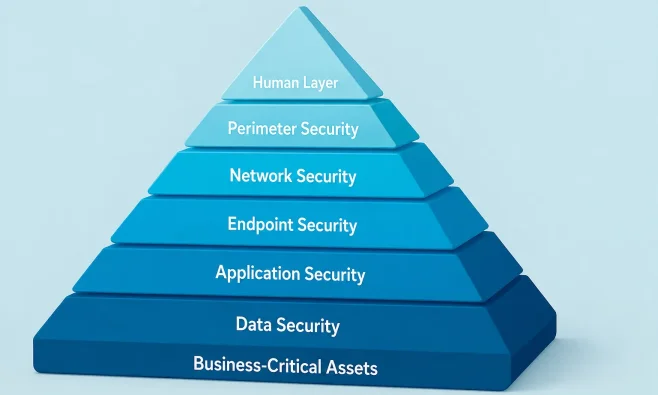
The modern seven layers
Together, these seven layers form the foundation of a future-proof cybersecurity strategy. We cover them one by one, so you understand exactly where your security efforts have the most impact and how they connect seamlessly.
1. Business-critical assets: focus on what really counts
This forms the heart of the modern approach: not all data is equal. By identifying and categorising business-critical assets, organisations can direct their security efforts to where they are needed most. For ISVs, tenant data, API keys, secrets and billing processes are often the crown jewels. Electronic patient records in healthcare or financial customer data in FinTech deserve the highest level of protection. Start with a free vulnerability scan to map your business-critical assets and gain immediate insight into vulnerabilities, so you can prioritise your security efforts.
2. Data security: from storage to transfer
This layer has undergone a dramatic evolution driven by cloud adoption. Where we once relied mainly on local backups, it now comes down to advanced encryption, cloud-native security tools and zero trust data governance. Data sovereignty and compliance have become crucial considerations. It's also important to know where your data is held. Full control over its location makes answering questions during an audit, for example, much easier. Choose hosting in Dutch data centres with full data sovereignty. With data centres in the Netherlands, you always know exactly where your data sits, essential for compliance and a smooth audit.
3. Application security: security by design
The biggest change here is the shift towards CI/CD (DevSecOps) and security by design. Rather than bolting security on afterwards, it is built into the development cycle from day one. Automated security testing, container security and API security are now standard components. This prevents downtime and delays earlier in the process. Smart monitoring naturally runs on your runtime to stop targeted attacks, and above all, it ensures you sail through your audit. Implement a WAF (Web Application Firewall) and a SIEM solution tailored specifically to your application. Configure these fully to your needs for real-time protection and compliance.
4. Endpoint security: beyond antivirus
This layer has been transformed by remote work and BYOD policies. Modern endpoint security includes Extended Detection and Response (XDR), behavioural analytics and cloud-managed security, managing devices centrally from the cloud. Traditional antivirus has been replaced by AI-driven threat detection that provides real-time protection against zero-day attacks. Alongside this, put policies in place for access controls and device compliance, and ensure 24/7 monitoring of your endpoints and infrastructure.
5. Network security: zero trust as the norm
Perhaps the biggest evolution of all: the shift from perimeter-based security to zero trust architecture. "Trust but verify" has been replaced by "never trust, always verify". Micro-segmentation, software-defined perimeters and continuous verification of sessions and identity are the new standards. Implement a managed firewall with UTM (Unified Threat Management) that is monitored around the clock.
6. Perimeter security: hybrid protection
This layer has adapted to hybrid IT environments. Alongside traditional firewalls and IDS/IPS systems, modern perimeter security now includes cloud access security brokers (CASB), secure web gateways and cloud-native firewalls that move with your workloads. It's also important to secure SaaS integrations and cloud workloads, and to integrate perimeter controls with IAM and monitoring. Protect your services against DDoS attacks with anti-DDoS services.
7. The human layer: from weak link to partner
Although still critical, the approach to this layer has changed fundamentally. People remain a critical factor, particularly in development and support teams. Rather than training and awareness alone, we now see human-centric security design, behavioural analytics to flag insider threats, and decision-making supported by AI-driven context. There is also an overarching principle at play here: identity as the new perimeter. A few other points fall under this layer too: for ISVs, Identity & Access Management (IAM) is often the real boundary, alongside role-based access control (RBAC) and least privilege, single sign-on and federation with customer IdPs, and just-in-time, just-enough access for support and admin roles. Invest in security awareness training for your team. Download the free Cyso white paper on cybersecurity best practices.
Smarter layers, not just more layers
Alongside the seven layers, there are overarching developments that strengthen every level:
Identity as the new perimeter
In the modern model, identity and access management is often treated as a separate, cross-cutting layer. With cloud-first strategies and remote work, identity has often become the only reliable security boundary.
AI and machine learning integration
Every layer is now supported by AI-driven security tools that recognise patterns, predict threats and can respond to incidents automatically.
Cloud-native security
The shared responsibility models used by cloud providers have fundamentally changed how security responsibilities are divided. Organisations now need to think about what they secure themselves versus what the cloud provider handles.
From checklist to continuous learning
Building layered cybersecurity remains a cyclical process, but with new methodologies:
Continuous assessment: prioritise where the business impact is greatest.
Risk-based approach: resources are deployed based on actual risk exposure.
Automation first: security processes are automated wherever possible.
Integration focus: security must be part of development, operations and support, not a silo.
Slowing down and detecting in the cloud era
The principle of slowing attackers down remains crucial, but its execution has evolved. Modern "defence in depth" is not just about more layers, but about smarter layers that learn from one another. Threat intelligence is shared between layers, and response actions are coordinated by Security Orchestration, Automation and Response (SOAR) platforms.
Security as a competitive advantage
For ISVs, security is not just a technical requirement but a commercial asset. Customers increasingly ask for ISO 27001, SOC 2 or PCI DSS during tenders and audits. A layered approach makes it easier to meet these requirements and to build trust. That turns security into a business enabler rather than a brake on innovation.
Conclusion: evolution, not revolution
The seven-layer model remains the foundation of strong cybersecurity, but its execution has changed fundamentally. Modern security is not about separate, static layers, but about an intelligent ecosystem that moves with threats and strengthens your business rather than holding it back.
Organisations investing in this integrated approach today are not just building better security, they are creating a competitive advantage. They sail through audits more smoothly, win customer trust and can innovate faster because security has been built in from day one.
Start your cybersecurity evolution today
Get in touch with us for a personal consultation on how we can support you in developing a modern, layered cybersecurity strategy that protects your organisation today and tomorrow.